



Pablo Medina (Corona): AI for warehouse decision-making
“AI starts with a decision, not a technology”
AI’s impact on operations
The executive course on artificial intelligence developed by MIT CTL and Mecalux gives business leaders practical insight into applying this technology to supply chain decision-making. The programme combines executive sessions, case studies and hands-on workshops focused on identifying high-value applications that deliver business results.
Pablo Medina attended the first edition of the executive course on artificial intelligence organised by MIT CTL and Mecalux. As Distribution Manager at the multinational Corona, manufacturer of home improvement and construction products, he shares his experience from the Massachusetts Institute of Technology.
-
What was your main takeaway from the executive course at MIT?
That AI starts with a decision, not a technology. I arrived thinking about algorithms and left thinking about simpler questions: What decision do we want to improve? Who makes it? How often do we make it, and how do we measure it today? Without that baseline, no pilot can demonstrate anything.
My second takeaway was understanding that machine learning and optimisation are partners, not rivals. The course presented five levels of integration, ranging from not using AI at all to having models make every decision. Most of the proven value in warehousing is currently found in the first two levels: the model makes a prediction, while the planning tool remains in control.
The rule I took away was to choose the simplest level that solves the bottleneck. For an integrated supply chain like Corona’s, that changes the conversation. It’s not about how much AI we use, but which decisions we apply it to and how deeply.
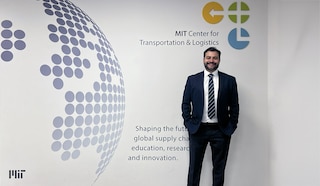
Pablo Medina built an optimisation model for Corona with MIT during the course -
What ideas did you find most interesting?
It was very useful to see each type of machine learning applied to a real-world case. During the course, we examined how different companies have used these models in their operations. Uber Freight, for instance, used unsupervised learning to identify facilities. The model did this by clustering GPS points from stationary trucks without relying on labelled data. We also looked at cases of supervised learning, which learns from data containing the correct answer. These included IKEA’s drones, which read labels on warehouse racking, and Zalando’s model, which mimics its routing algorithm to estimate travel times in milliseconds. Another example was Amazon’s use of reinforcement learning for inventory purchasing. The model tested different decisions in a simulated environment.
Of the cases we studied, the one that made the biggest impression on me was the supervised model developed by MIT CTL. Rather than providing a single figure, it predicts transit times as a range. For example, an estimated 10-day journey may appear better than an 11-day one. But when you see that the first can take more than two days longer than expected while the second deviates by barely half a day, the picture changes. In Colombia, where geography and road conditions make transport highly variable, that difference is critical when determining safety stock levels, dock appointments and staffing schedules.
The Amazon case also made me think. Its model for deciding how much of each product to purchase promised to reduce inventory by nearly 23% in a simulation. However, the figure ultimately fell by 12% in a real-world, 26-week trial. That was still a good result, but the lesson is to measure outcomes before scaling up.
-
Did anything make you rethink your view of AI?
What challenged my perspective most was realising that AI is not neutral. An MIT study showed that a generative AI copilot not only improved people’s decisions but also influenced the importance they placed on risk and profitability when making them. That’s why the degree of autonomy should be defined for each type of decision, with a clear person accountable for it.
Machine learning and optimisation are partners, not rivals
-
Has the course helped you identify new opportunities for AI at your company? How would you apply it to a specific challenge at Corona?
The AI course gave me a framework for tackling a challenge we already faced. At Corona, we worked with MIT to build an optimisation model for vehicle loading and route planning, and we learned that the algorithm is only one part of the equation. The other is ensuring that users can work with it and that the input data are reliable.
The course showed how AI agents can coordinate optimisation tools. For example, a supervising agent receives an objective, such as shipping the next day’s orders. A data agent queries the company’s systems and validates the information, the optimiser builds the plan, and an execution agent turns it into tasks and alerts. People set goals and limits, approve exceptions and take control whenever there are questions.
The key is to move forward in stages. First, establish reliable data and introduce a copilot that explains the plan. Next, grant more autonomy only where errors are inexpensive and reversible. I’d structure it as a 90-day pilot at a distribution centre. Initially, it would run in parallel with current operations and then move to an assisted mode, with clear criteria for continuing or stopping.
Productivity gains can emerge at all three stages of the process. At the input stage, agents validate orders, weights, dimensions, delivery windows and available vehicles before each execution. This allows the bin-packing and vehicle routing problem (VRP) models to work with complete data and prevents repeated runs. During the process, the planner evaluates scenarios in minutes and focuses on exceptions instead of adjusting plans manually. At the output stage, an agent turns the plan into loading sequences, instructions and alerts, while logging each deviation to improve the data used in the next run. The expected result is higher vehicle utilisation, fewer trips and kilometres, less time spent scheduling and plans carried out as designed.
-
What did you value most about sharing experiences with executives from other industries?
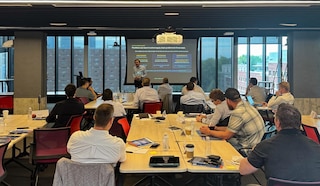
The degree of AI autonomy should be defined for each type of decision, with a clear person accountable Discovering that our problems are far more similar than I’d thought. At my table, there were people from retail, manufacturing and logistics, and nearly all of us recognised the same challenges: scattered data, siloed decision-making and pilots that never make it into day-to-day operations.
That reinforced something the course emphasised: patterns transfer across sectors. A freight transport or e-commerce case can teach a manufacturing company like ours a great deal if you ask where that same decision exists in your own operation.
I also valued the role of a “critical friend”. During the workshops, my fellow participants challenged my baselines and assumptions with a level of candour that can be difficult to find within your own organisation. I learned that when several teams share the same risk assumption, the problem doesn’t belong to one company — it’s an industry-wide gap.
-
What would you tell a colleague who was considering taking a similar course?
I’d tell them to go — but not empty-handed. Participants will get much more out of the course if they arrive with a real operational decision in mind, a person responsible for it and some numbers showing how it works today, even if they’re only rough estimates.
I’d also tell them not to expect a programming course. The value lies in leaving with a framework for thinking: how to analyse a case, choose the right type of machine learning, determine the appropriate level of integration and design a pilot that leads to a decision rather than a demonstration.
Finally, prospective participants should think about people from the outset. The models are the easy part. The challenge is getting supervisors, IT teams and software providers to trust the results and use them. And when they return from the course, they should send the first data request that same week — because that’s where the pilot truly begins.