



The number of companies adding a chief artificial intelligence officer (CAIO) to their executive ranks continues to grow. A survey by the IBM Institute for Business Value, conducted in collaboration with Dubai Future Foundation and Oxford Economics, found that 26% of organisations now have a CAIO on staff. Moreover, companies that have created this role report a 10% higher return on investment (ROI) from their AI initiatives.
The authors of Solving the AI ROI puzzle note that senior executives are no longer satisfied with experimenting with AI — they are now focused on achieving measurable results. However, many organisations still struggle to scale AI-driven growth. This is where the chief AI officer comes in, with a mandate to deliver outcomes and generate incremental value.
CAIOs define their companies’ AI strategy, lead implementation and oversee budgets tied to this technology, along with the organisational changes required to execute their plans. Some 57% report directly to the CEO or the board, and in 76% of cases, other executives consult them on AI-related decisions. While companies worldwide have invested billions in AI, many initiatives remain in the pilot phase, highlighting the need for this emerging role.
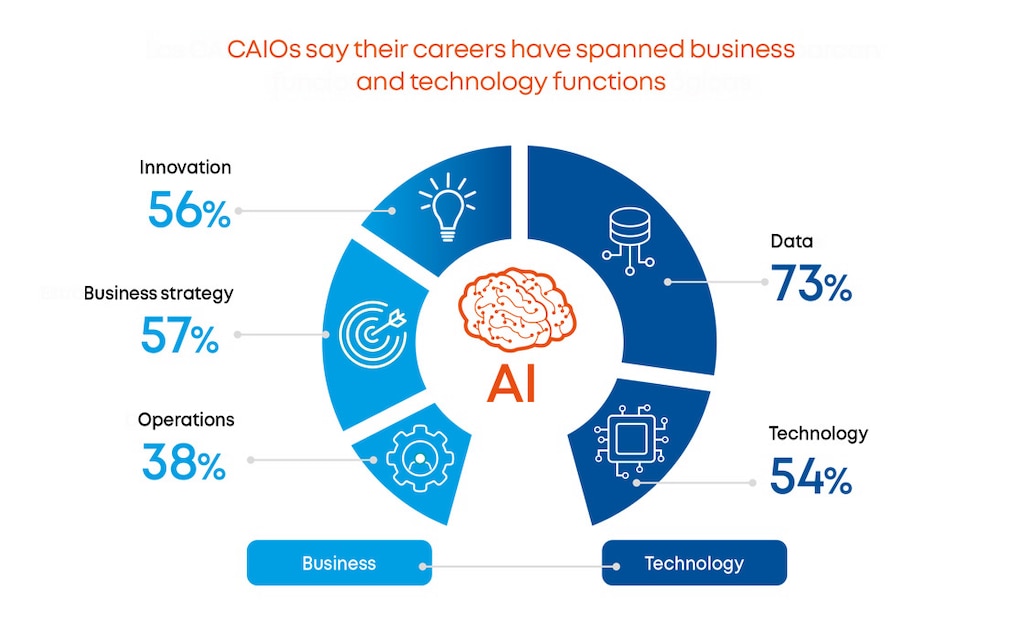
Question: Thinking about your career as a whole, in which of the following areas have you focused?
A strategic role
Data expertise is one of the most critical skills for CAIOs, with 73% reporting experience in this area. At the same time, they bring strong backgrounds in business strategy, enterprise technology, innovation and operations. Their role is to identify high-value opportunities and work alongside other leaders to advance transformation from multiple fronts. Ultimately, CAIOs act as visionaries leading the rollout of AI initiatives and serving as a bridge across related portfolios.