


SCALE Connect brought Mecalux to MIT to exchange ideas with international Supply Chain Management master’s students
Mecalux took part in an executive session at the Massachusetts Institute of Technology (MIT) with master’s students in the MIT Global SCALE Network, an international alliance of leading research centres in supply chain and logistics. Hosted by the MIT Center for Transportation and Logistics (CTL) and moderated by Matthias Winkenbach, Director of Research at MIT CTL, SCALE Connect included perspectives from Mecalux’s Chief Technology Officer, Iñaki Fernández, and an open discussion with students.
Held on January 14, the session explored major shifts in intralogistics, including robotics, warehouse execution software (WES), artificial intelligence and the methods used to design and validate automated operations.
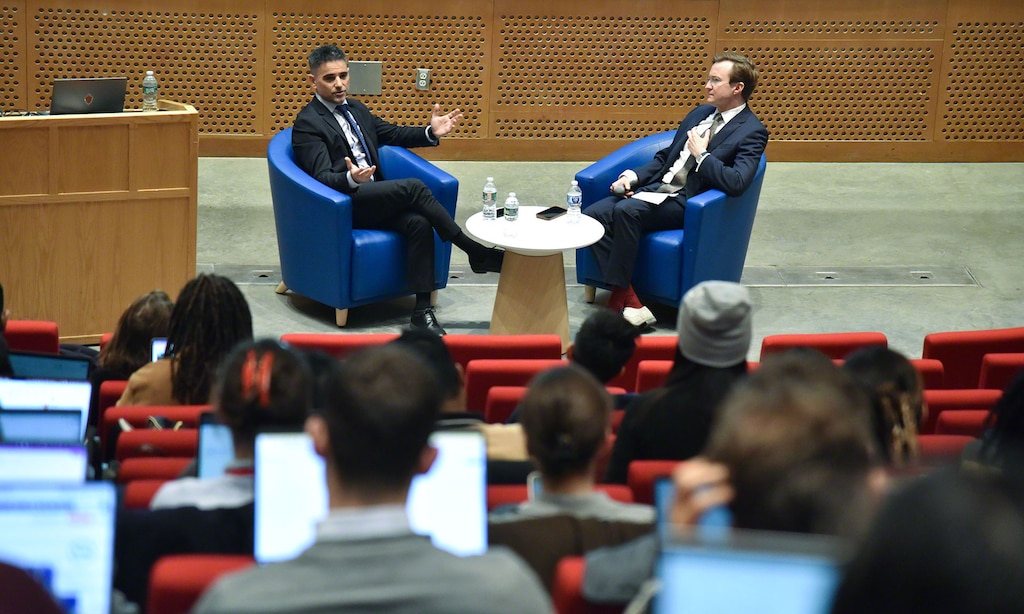
The event explored the trends shaping global storage strategy
Photo: © Chris Frontiero, MIT
Speakers and students discussed the industry’s shift towards flexible and modular automation designed to scale with changing business needs. Topics included the growing adoption of autonomous mobile robots (AMRs), high-density solutions such as 3D shuttle AS/RS and the increasing importance of orchestration software to coordinate diverse technologies across end-to-end warehouse operations.
“AI is already powering forecasting, routing and inventory optimisation. The next frontier is translating AI-driven intelligence into physical dexterity,” said Fernández.
The discussion also focused on what it takes to make automation successful in real operations. Attention to process redesign, operational training, rigorous validation and realistic time-to-value expectations remains critical to delivering measurable performance improvements after go-live.
“Bringing industry leaders into the classroom gives students a direct view into how complex supply chain systems are designed and operated in practice. Conversations like this help bridge research, real-world constraints and the next wave of innovation in logistics,” said Winkenbach.
Innovation priorities: flexibility, sustainability and workforce transformation
The discussion also addressed wider trends shaping warehouse strategy worldwide. One key shift is the move towards more flexible investment models, where modular automation enables incremental growth and greater adaptability as demand changes. Sustainability was another priority, with an increasing focus on energy-efficient system design to support lower-impact warehouse operations over the long term.
Finally, the conversation highlighted how automation is changing workforce needs across the industry. As warehouses become more technology-driven, companies are placing greater emphasis on roles and expertise in mechatronics, controls, robotics, fleet management, software development and data-driven operations.
This exchange is part of a broader collaboration between MIT CTL and Mecalux, supported by a five-year research collaboration to advance new technologies for warehousing and logistics.
About MIT CTL
The MIT Center for Transportation & Logistics (MIT CTL) is a world leader in supply chain management research and education, with over 50 years of expertise. The centre’s work spans industry partnerships, cutting-edge research and driving supply chain innovation into practice through three pillars: research, outreach and education.