


Putting AI to work in such augmenting ways can deliver unprecedented financial benefits
IN-DEPTH ANALYSIS
By David de Cremer
Adopting AI is — symbolically speaking — a no-brainer for businesses to grow today, for three reasons. First, AI is undoubtedly an excellent tool for a volatile, uncertain, complex and ambiguous world, where the ability to learn from and act on ever-increasing amounts of data is of utmost importance.
Second, AI is helpful for promoting an organisation’s innovation potential and, hence, its level of competitiveness. Companies using AI will enable employees to work faster and be better informed, making them more productive. Increasing productivity, in turn, will give people more time and space to be creative, experiment with new ideas and drive innovation. Putting AI to work in such augmenting ways can deliver unprecedented financial benefits. After all, AI is predicted to add about $16 trillion to the global economy.
Putting AI to work in such augmenting ways can deliver unprecedented financial benefits
Third, the economics of adopting AI are becoming more favourable. The underlying machine-learning and deep-learning techniques that power AI systems are often open-source, and cloud-based services for storing and processing data are increasingly commonplace and inexpensive. So, there is no excuse any more not to be part of the mad rush to eat from that $16 trillion pie.
A crucial distinction
At the same time, AI is — literally speaking — a no-brainer because it has no human-level intellectual abilities. Today, we seem to be suffering through a cycle of hype with AI that does not match reality because people don’t understand this crucial distinction. The hype has fuelled excessive optimism to the extent that many people think AI systems are already matching human intellectual abilities. They believe that it is only a matter of time before this technology can perfectly replicate the human brain. And when that happens, expensive and not-always-efficient employees can be replaced by much cheaper AI capable of self-learning.
We seem to be suffering through a cycle of hype with AI that does not match reality
This kind of thinking, however, may even be dangerous. Brain scientists themselves argue that our understanding of the human brain — with its approximately 86 billion interacting neurons — is sketchy and provisional at most. With such incomplete knowledge about the brain, we cannot seriously say that we have succeeded in matching AI with human intelligence. At best, we brought to the fore a narrow kind of computational intelligence that can complement it — but not replace it. We should stop comparing machines and humans so explicitly in this regard. It’s like comparing apples and oranges.
Still, some people think that’s the endgame: make AI more and more like the brain. As a leader, you have a decision to make. Which of these two perspectives do you adopt when bringing AI into your organisation?
- Perspective 1: AI is an increasingly cheap way to replace people and achieve new levels of productivity and efficiency.
- Perspective 2: It’s a powerful tool to augment — but not replace — human intelligence, unlocking more innovation and creativity in workers.
If you go for the first perspective, then you accept that the primary focus of organisations today is to employ AI to make the best use of data and, eventually, to delegate decision-making and thinking to this tool. Some may find this an attractive option. The irony is that leaders who think this way are, over time, ceding their leadership to AI.
If you opt for the second perspective, you accept that AI is limited in its ability to do what we expect our human employees to do. Investing in humans will then be the priority, and leaders will have to take active charge of the AI adoption project to complement that core strategy.

Machine-like thinking
Today, most AI initiatives follow perspective 1. Organisations primarily see financial benefits and want to optimise efficiency and performance across the board, prioritising machine-like thinking over human thinking. I call this phenomenon the “tech-driving-tech transformations”, and make no mistake, they’re happening. People are valuing AI’s computational prowess over human understanding. They’re letting it lead.
People are valuing AI’s computational prowess over human understanding. They’re letting it lead
For instance, in 2022, the Synthetic Party was established in Denmark. Its leader is an AI chatbot called Lars. Or, consider the Chinese company NetDragon Websoft, which develops multiplayer online games. The organisation operates in the metaverse and has recently appointed a robot, called Tang Yu, as its CEO.
These examples align with the business world’s emerging belief that the ability to read data rapidly and accurately should become the standard for how leaders think. I observe this not only when visiting companies deeply engaged in AI adoption projects but also in my classroom. When I teach advanced leadership courses for executives, participants increasingly ask: “But, Professor, in today’s context of digital priorities, why should we still learn interpersonal skills? Shouldn’t I learn to become a coder and think more like an AI expert?” Questions like these reflect the idea that today’s leadership training should centre on acquiring the abilities and mindset that fit with how AI works and reasons.
Human leadership
In a world dominated by digital technology, human leadership matters now more than before AI. The AI-savvy leader is the one who takes perspective 2 — that this technology can become a partner to human workers — and drives that kind of transformation successfully in their organisations.
It is time for business leaders to look in the mirror, cast aside their doubts and embrace their leadership capabilities for this new challenge. With AI systematically becoming a part of how companies operate, we need our leaders — with their interpersonal, motivational, business and perspective 2 skills — more than ever. The imperative today should be that classic business leadership is a prerequisite to deploying AI effectively, not an obstacle.
Human leadership matters now more than before AI
The key to being a successful AI-savvy leader will be to ensure that the right conditions are created to make human-AI collaborations work and adopt a human-centred focus. In other words, humans come first, AI second.
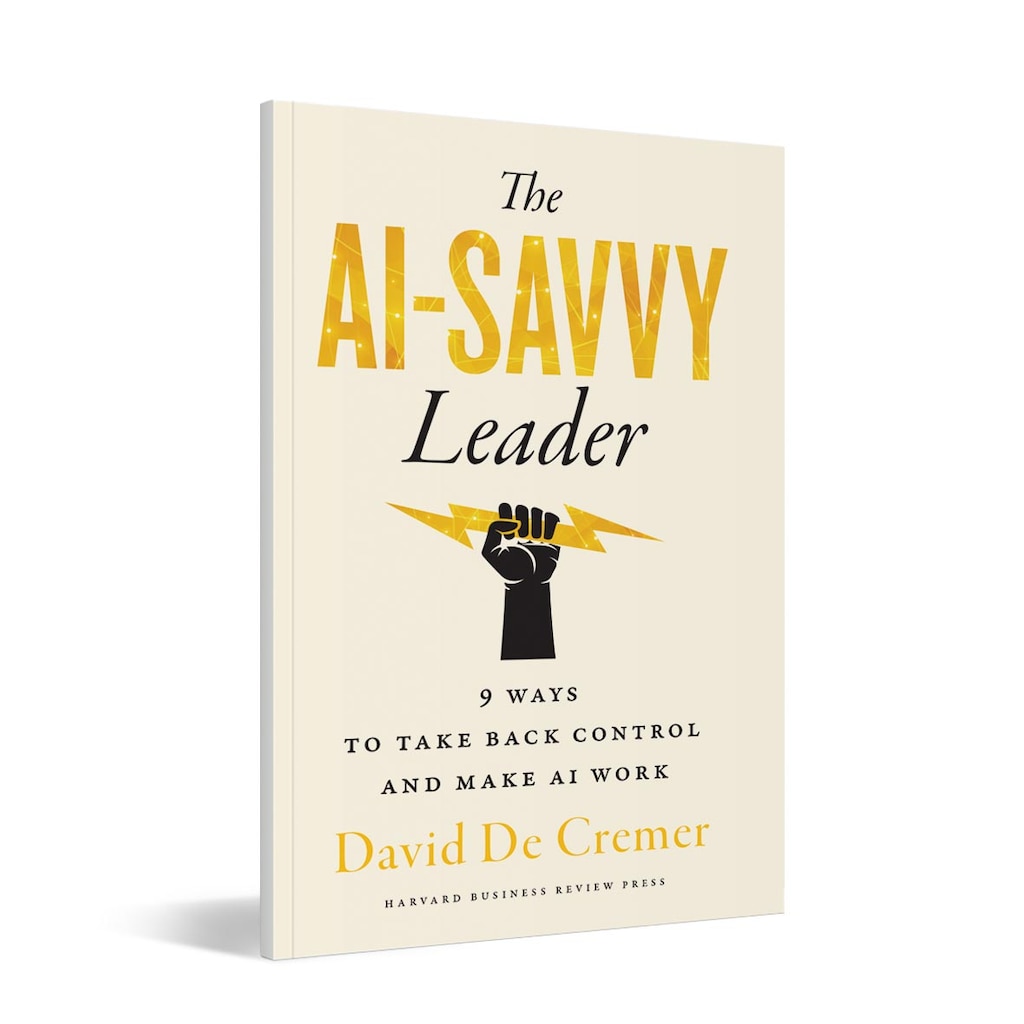 |
Reprinted by permission of Harvard Business Review Press. Excerpted and edited from The AI-savvy leader: Nine ways to take back control and make AI work. Copyright 2024 Harvard Business School Publishing Corporation. All rights reserved. |
ABOUT THE AUTHOR
 |
DAVID DE CREMER David de Cremer is the Dunton Family Dean at Northeastern University’s D’Amore-McKim School of Business, where he teaches Management and Technology. Previously, he was a professor at the National University of Singapore (NUS) Business School, where he founded and led the Centre on AI Technology for Humankind (AiTH). He also serves on the advisory board for global AI projects at the consultancy EY. |
References
- Gregory, R. W., et al. The Role of Artificial Intelligence and Data Network Effects for Creating User Value. Academy of Management Review, Vol. 46, No. 3, Pp. 534–551. (2021).
- Rao, Anand S., Verweij, Gerard. Sizing the Prize: What's the Real Value of AI for Your Business and How Can You Capitalise? PwC. (2017).
- von Krogh, G., Artificial Intelligence in Organizations: New Opportunities for Phenomenon-Based Theorizing. Academy of Management Discoveries 4, Vol. 4, No. 4, Pp. 404–409. (2018).
- Voytek, Bradley. Are There Really as Many Neurons in the Human Brain as Stars in the Milky Way?. Scitable, Nature Education. (2013).