


Reports from both organisations warn that AI is “no longer optional” in warehousing and omnichannel supply chains
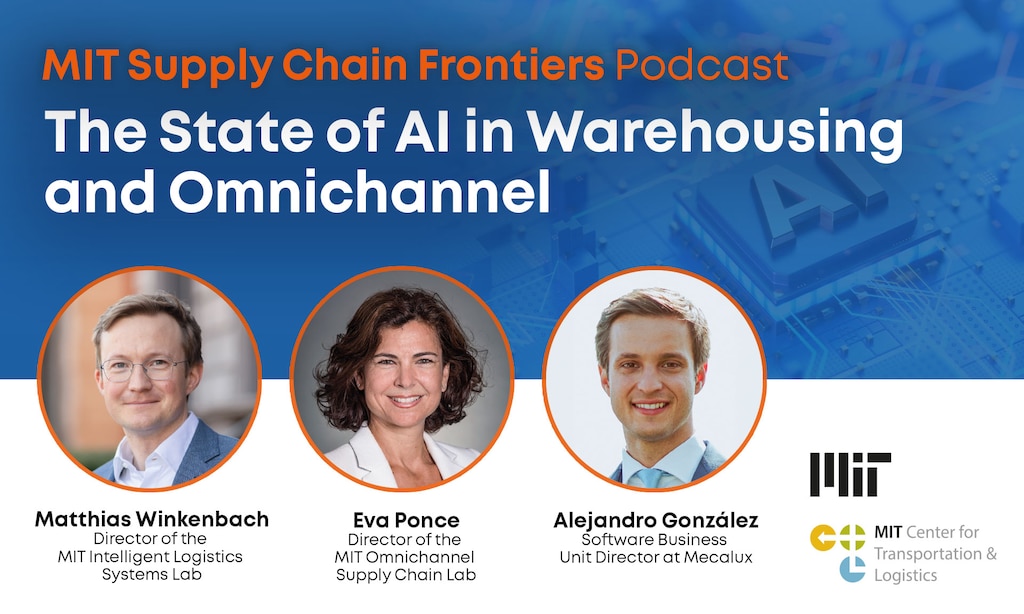
The MIT Center for Transportation & Logistics podcast, Supply Chain Frontiers, has analysed the findings of its 2026 state of omnichannel supply chain report and The state of AI in warehousing report, the latter produced in collaboration with Mecalux. In this episode, Matthias Winkenbach, Director of the MIT Intelligent Logistics Systems Lab; Eva Ponce, Director of the MIT Omnichannel Supply Chain Lab; and Alejandro González, Software Business Unit Director at Mecalux, conclude that “artificial intelligence has moved from experimentation to operational necessity”.
The joint MIT–Mecalux report shows that AI has seen near-universal adoption in warehouse operations. “Only about 1% of all of our respondents indicated they are not already using or at least piloting AI,” said Winkenbach. His lab has recently developed GENESIS, an AI-based simulator designed to optimise inventory across warehouses, in collaboration with Mecalux. “A traditional optimisation model would give us the same solution in three days, but we need an answer in three minutes. And that’s really where AI comes in,” said Winkenbach.
This technology is delivering benefits across multiple industries, including the fast-growing e-commerce sector. The omnichannel supply chain study reveals that 80% of organisations in the sector are experiencing growth. “Customers are asking for faster and more reliable deliveries. From the operational side, this requires much more precision,” said Ponce.
AI has become a critical requirement. As a result, companies are prioritising investments in initiatives with a clear and measurable financial impact. “The strongest use cases tend to be in areas that affect the cost per order,” said González. “Examples include improving inventory accuracy, optimising picking workflows and allocating labour to tasks in a more efficient way.”
Listen to the full episode of MIT Supply Chain Frontiers to learn how AI is transforming supply chain operations.